2026-02-13 09:25:15 +08:00
# 🦌 DeerFlow - 2.0
2026-03-25 03:39:38 +03:00
English | [中文 ](./README_zh.md ) | [日本語 ](./README_ja.md ) | [Français ](./README_fr.md ) | [Русский ](./README_ru.md )
2026-03-17 13:51:01 +08:00
[](./backend/pyproject.toml)
[](./Makefile)
[](./LICENSE)
2026-02-28 16:20:26 +08:00
<a href="https://trendshift.io/repositories/14699" target="_blank"><img src="https://trendshift.io/api/badge/repositories/14699" alt="bytedance%2Fdeer-flow | Trendshift" style="width: 250px; height: 55px;" width="250" height="55"/></a>
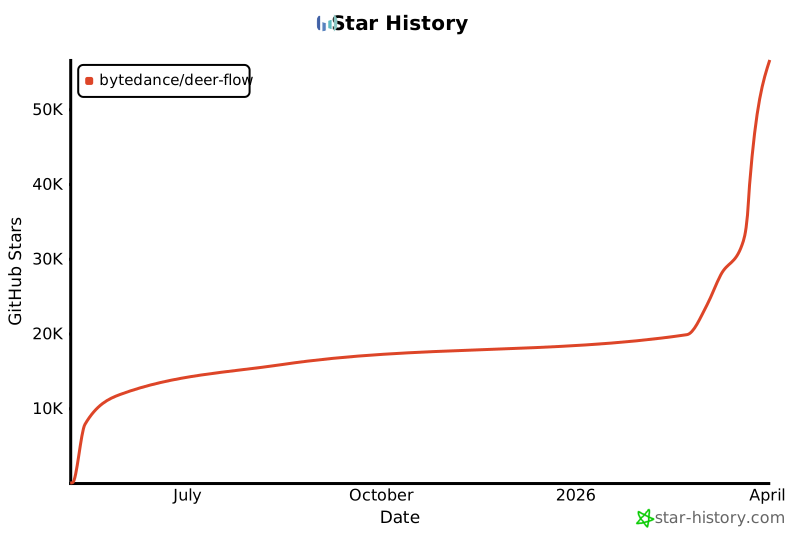
> On February 28th, 2026, DeerFlow claimed the 🏆 #1 spot on GitHub Trending following the launch of version 2. Thanks a million to our incredible community — you made this happen! 💪🔥
2026-02-13 09:38:35 +08:00
DeerFlow (**D**eep **E**xploration and **E**fficient **R**esearch **Flow ** ) is an open-source **super agent harness ** that orchestrates **sub-agents ** , **memory ** , and **sandboxes ** to do almost anything — powered by **extensible skills ** .
2026-02-13 09:25:15 +08:00
2026-02-14 23:48:29 +08:00
https://github.com/user-attachments/assets/a8bcadc4-e040-4cf2-8fda-dd768b999c18
2026-02-13 09:25:15 +08:00
> [!NOTE]
2026-02-14 21:30:37 +08:00
> **DeerFlow 2.0 is a ground-up rewrite.** It shares no code with v1. If you're looking for the original Deep Research framework, it's maintained on the [`1.x` branch](https://github.com/bytedance/deer-flow/tree/main-1.x) — contributions there are still welcome. Active development has moved to 2.0.
2026-02-13 09:25:15 +08:00
2026-03-01 13:09:57 +08:00
## Official Website
2026-02-14 23:48:29 +08:00
2026-03-17 14:33:47 +08:00
[<img width="2880" height="1600" alt="image" src="https://github.com/user-attachments/assets/a598c49f-3b2f-41ea-a052-05e21349188a" /> ](https://deerflow.tech )
2026-02-14 23:48:29 +08:00
2026-03-17 14:33:47 +08:00
Learn more and see **real demos ** on our [**official website** ](https://deerflow.tech ).
## Coding Plan from ByteDance Volcengine
<img width="4808" height="2400" alt="英文方舟" src="https://github.com/user-attachments/assets/2ecc7b9d-50be-4185-b1f7-5542d222fb2d" />
- We strongly recommend using Doubao-Seed-2.0-Code, DeepSeek v3.2 and Kimi 2.5 to run DeerFlow
- [Learn more ](https://www.byteplus.com/en/activity/codingplan?utm_campaign=deer_flow&utm_content=deer_flow&utm_medium=devrel&utm_source=OWO&utm_term=deer_flow )
- [中国大陆地区的开发者请点击这里 ](https://www.volcengine.com/activity/codingplan?utm_campaign=deer_flow&utm_content=deer_flow&utm_medium=devrel&utm_source=OWO&utm_term=deer_flow )
2026-02-14 23:48:29 +08:00
2026-03-06 15:32:13 +08:00
## InfoQuest
DeerFlow has newly integrated the intelligent search and crawling toolset independently developed by BytePlus--[InfoQuest (supports free online experience) ](https://docs.byteplus.com/en/docs/InfoQuest/What_is_Info_Quest )
<a href="https://docs.byteplus.com/en/docs/InfoQuest/What_is_Info_Quest" target="_blank">
2026-03-17 13:51:01 +08:00
<img
src="https://sf16-sg.tiktokcdn.com/obj/eden-sg/hubseh7bsbps/20251208-160108.png" alt="InfoQuest_banner"
2026-03-06 15:32:13 +08:00
/>
</a>
2026-02-14 23:48:29 +08:00
---
2026-02-13 09:25:15 +08:00
## Table of Contents
2026-03-01 22:38:58 +08:00
- [🦌 DeerFlow - 2.0 ](#-deerflow---20 )
2026-03-05 07:25:30 +08:00
- [Official Website ](#official-website )
2026-03-08 21:06:57 +08:00
- [InfoQuest ](#infoquest )
2026-03-01 22:38:58 +08:00
- [Table of Contents ](#table-of-contents )
2026-03-26 21:39:34 +08:00
- [One-Line Agent Setup ](#one-line-agent-setup )
2026-03-01 22:38:58 +08:00
- [Quick Start ](#quick-start )
- [Configuration ](#configuration )
- [Running the Application ](#running-the-application )
- [Option 1: Docker (Recommended) ](#option-1-docker-recommended )
- [Option 2: Local Development ](#option-2-local-development )
- [Advanced ](#advanced )
- [Sandbox Mode ](#sandbox-mode )
- [MCP Server ](#mcp-server )
2026-03-12 22:18:18 +08:00
- [IM Channels ](#im-channels )
2026-03-27 14:17:45 +08:00
- [LangSmith Tracing ](#langsmith-tracing )
2026-03-01 22:38:58 +08:00
- [From Deep Research to Super Agent Harness ](#from-deep-research-to-super-agent-harness )
- [Core Features ](#core-features )
- [Skills \& Tools ](#skills--tools )
2026-03-08 22:06:24 +08:00
- [Claude Code Integration ](#claude-code-integration )
2026-03-01 22:38:58 +08:00
- [Sub-Agents ](#sub-agents )
- [Sandbox \& File System ](#sandbox--file-system )
- [Context Engineering ](#context-engineering )
- [Long-Term Memory ](#long-term-memory )
- [Recommended Models ](#recommended-models )
2026-03-08 21:06:57 +08:00
- [Embedded Python Client ](#embedded-python-client )
2026-03-01 22:38:58 +08:00
- [Documentation ](#documentation )
2026-03-26 21:24:52 +08:00
- [⚠️ Security Notice ](#️ )
2026-03-01 22:38:58 +08:00
- [Contributing ](#contributing )
- [License ](#license )
- [Acknowledgments ](#acknowledgments )
- [Key Contributors ](#key-contributors )
- [Star History ](#star-history )
2026-01-16 14:44:51 +08:00
2026-03-26 21:39:34 +08:00
## One-Line Agent Setup
If you use Claude Code, Codex, Cursor, Windsurf, or another coding agent, you can hand it the setup instructions in one sentence:
```text
Help me clone DeerFlow if needed, then bootstrap it for local development by following https://raw.githubusercontent.com/bytedance/deer-flow/main/Install.md
```
That prompt is intended for coding agents. It tells the agent to clone the repo if needed, choose Docker when available, and stop with the exact next command plus any missing config the user still needs to provide.
2026-01-16 14:44:51 +08:00
## Quick Start
2026-02-12 11:02:09 +08:00
### Configuration
2026-01-24 22:01:00 +08:00
2026-02-21 07:48:20 +08:00
1. **Clone the DeerFlow repository **
2026-02-18 19:29:25 +08:00
```bash
2026-02-21 07:48:20 +08:00
git clone https://github.com/bytedance/deer-flow.git
cd deer-flow
2026-02-18 19:29:25 +08:00
```
2026-02-21 07:48:20 +08:00
2. **Generate local configuration files **
From the project root directory (`deer-flow/` ), run:
2026-01-16 14:44:51 +08:00
```bash
2026-02-19 09:04:37 +08:00
make config
2026-01-16 14:44:51 +08:00
```
2026-02-21 07:48:20 +08:00
This command creates local configuration files based on the provided example templates.
2026-02-19 09:04:37 +08:00
2026-02-21 07:48:20 +08:00
3. **Configure your preferred model(s) **
2026-02-12 11:02:09 +08:00
2026-02-21 07:48:20 +08:00
Edit `config.yaml` and define at least one model:
2026-02-12 11:02:09 +08:00
2026-02-21 07:48:20 +08:00
```yaml
models:
- name: gpt-4 # Internal identifier
display_name: GPT-4 # Human-readable name
use: langchain_openai:ChatOpenAI # LangChain class path
model: gpt-4 # Model identifier for API
api_key: $OPENAI_API_KEY # API key (recommended: use env var)
max_tokens: 4096 # Maximum tokens per request
temperature: 0.7 # Sampling temperature
2026-03-13 07:12:30 -07:00
- name: openrouter-gemini-2.5-flash
display_name: Gemini 2.5 Flash (OpenRouter)
use: langchain_openai:ChatOpenAI
model: google/gemini-2.5-flash-preview
api_key: $OPENAI_API_KEY # OpenRouter still uses the OpenAI-compatible field name here
base_url: https://openrouter.ai/api/v1
2026-03-22 20:39:26 +08:00
- name: gpt-5-responses
display_name: GPT-5 (Responses API)
use: langchain_openai:ChatOpenAI
model: gpt-5
api_key: $OPENAI_API_KEY
use_responses_api: true
output_version: responses/v1
2026-02-21 07:48:20 +08:00
```
2026-02-12 11:02:09 +08:00
2026-03-13 07:12:30 -07:00
OpenRouter and similar OpenAI-compatible gateways should be configured with `langchain_openai:ChatOpenAI` plus `base_url` . If you prefer a provider-specific environment variable name, point `api_key` at that variable explicitly (for example `api_key: $OPENROUTER_API_KEY` ).
2026-03-22 20:39:26 +08:00
To route OpenAI models through `/v1/responses` , keep using `langchain_openai:ChatOpenAI` and set `use_responses_api: true` with `output_version: responses/v1` .
2026-03-22 07:39:50 -07:00
CLI-backed provider examples:
```yaml
models:
- name: gpt-5.4
display_name: GPT-5.4 (Codex CLI)
use: deerflow.models.openai_codex_provider:CodexChatModel
model: gpt-5.4
supports_thinking: true
supports_reasoning_effort: true
- name: claude-sonnet-4.6
display_name: Claude Sonnet 4.6 (Claude Code OAuth)
use: deerflow.models.claude_provider:ClaudeChatModel
model: claude-sonnet-4-6
max_tokens: 4096
supports_thinking: true
```
- Codex CLI reads `~/.codex/auth.json`
- The Codex Responses endpoint currently rejects `max_tokens` and `max_output_tokens` , so `CodexChatModel` does not expose a request-level token cap
- Claude Code accepts `CLAUDE_CODE_OAUTH_TOKEN` , `ANTHROPIC_AUTH_TOKEN` , `CLAUDE_CODE_OAUTH_TOKEN_FILE_DESCRIPTOR` , `CLAUDE_CODE_CREDENTIALS_PATH` , or plaintext `~/.claude/.credentials.json`
feat(harness): integration ACP agent tool (#1344)
* refactor: extract shared utils to break harness→app cross-layer imports
Move _validate_skill_frontmatter to src/skills/validation.py and
CONVERTIBLE_EXTENSIONS + convert_file_to_markdown to src/utils/file_conversion.py.
This eliminates the two reverse dependencies from client.py (harness layer)
into gateway/routers/ (app layer), preparing for the harness/app package split.
Co-Authored-By: Claude Opus 4.6 <noreply@anthropic.com>
* refactor: split backend/src into harness (deerflow.*) and app (app.*)
Physically split the monolithic backend/src/ package into two layers:
- **Harness** (`packages/harness/deerflow/`): publishable agent framework
package with import prefix `deerflow.*`. Contains agents, sandbox, tools,
models, MCP, skills, config, and all core infrastructure.
- **App** (`app/`): unpublished application code with import prefix `app.*`.
Contains gateway (FastAPI REST API) and channels (IM integrations).
Key changes:
- Move 13 harness modules to packages/harness/deerflow/ via git mv
- Move gateway + channels to app/ via git mv
- Rename all imports: src.* → deerflow.* (harness) / app.* (app layer)
- Set up uv workspace with deerflow-harness as workspace member
- Update langgraph.json, config.example.yaml, all scripts, Docker files
- Add build-system (hatchling) to harness pyproject.toml
- Add PYTHONPATH=. to gateway startup commands for app.* resolution
- Update ruff.toml with known-first-party for import sorting
- Update all documentation to reflect new directory structure
Boundary rule enforced: harness code never imports from app.
All 429 tests pass. Lint clean.
Co-Authored-By: Claude Opus 4.6 <noreply@anthropic.com>
* chore: add harness→app boundary check test and update docs
Add test_harness_boundary.py that scans all Python files in
packages/harness/deerflow/ and fails if any `from app.*` or
`import app.*` statement is found. This enforces the architectural
rule that the harness layer never depends on the app layer.
Update CLAUDE.md to document the harness/app split architecture,
import conventions, and the boundary enforcement test.
Co-Authored-By: Claude Opus 4.6 <noreply@anthropic.com>
* feat: add config versioning with auto-upgrade on startup
When config.example.yaml schema changes, developers' local config.yaml
files can silently become outdated. This adds a config_version field and
auto-upgrade mechanism so breaking changes (like src.* → deerflow.*
renames) are applied automatically before services start.
- Add config_version: 1 to config.example.yaml
- Add startup version check warning in AppConfig.from_file()
- Add scripts/config-upgrade.sh with migration registry for value replacements
- Add `make config-upgrade` target
- Auto-run config-upgrade in serve.sh and start-daemon.sh before starting services
- Add config error hints in service failure messages
Co-Authored-By: Claude Opus 4.6 <noreply@anthropic.com>
* fix comments
* fix: update src.* import in test_sandbox_tools_security to deerflow.*
Co-Authored-By: Claude Opus 4.6 <noreply@anthropic.com>
* fix: handle empty config and search parent dirs for config.example.yaml
Address Copilot review comments on PR #1131:
- Guard against yaml.safe_load() returning None for empty config files
- Search parent directories for config.example.yaml instead of only
looking next to config.yaml, fixing detection in common setups
Co-Authored-By: Claude Opus 4.6 <noreply@anthropic.com>
* fix: correct skills root path depth and config_version type coercion
- loader.py: fix get_skills_root_path() to use 5 parent levels (was 3)
after harness split, file lives at packages/harness/deerflow/skills/
so parent×3 resolved to backend/packages/harness/ instead of backend/
- app_config.py: coerce config_version to int() before comparison in
_check_config_version() to prevent TypeError when YAML stores value
as string (e.g. config_version: "1")
- tests: add regression tests for both fixes
Co-Authored-By: Claude Sonnet 4.6 <noreply@anthropic.com>
* fix: update test imports from src.* to deerflow.*/app.* after harness refactor
Co-Authored-By: Claude Sonnet 4.6 <noreply@anthropic.com>
* feat(harness): add tool-first ACP agent invocation (#37)
* feat(harness): add tool-first ACP agent invocation
* build(harness): make ACP dependency required
* fix(harness): address ACP review feedback
* feat(harness): decouple ACP agent workspace from thread data
ACP agents (codex, claude-code) previously used per-thread workspace
directories, causing path resolution complexity and coupling task
execution to DeerFlow's internal thread data layout. This change:
- Replace _resolve_cwd() with a fixed _get_work_dir() that always uses
{base_dir}/acp-workspace/, eliminating virtual path translation and
thread_id lookups
- Introduce /mnt/acp-workspace virtual path for lead agent read-only
access to ACP agent output files (same pattern as /mnt/skills)
- Add security guards: read-only validation, path traversal prevention,
command path allowlisting, and output masking for acp-workspace
- Update system prompt and tool description to guide LLM: send
self-contained tasks to ACP agents, copy results via /mnt/acp-workspace
- Add 11 new security tests for ACP workspace path handling
Co-Authored-By: Claude Opus 4.6 <noreply@anthropic.com>
* refactor(prompt): inject ACP section only when ACP agents are configured
The ACP agent guidance in the system prompt is now conditionally built
by _build_acp_section(), which checks get_acp_agents() and returns an
empty string when no ACP agents are configured. This avoids polluting
the prompt with irrelevant instructions for users who don't use ACP.
Co-Authored-By: Claude Opus 4.6 <noreply@anthropic.com>
* fix lint
* fix(harness): address Copilot review comments on sandbox path handling and ACP tool
- local_sandbox: fix path-segment boundary bug in _resolve_path (== or startswith +"/")
and add lookahead in _resolve_paths_in_command regex to prevent /mnt/skills matching
inside /mnt/skills-extra
- local_sandbox_provider: replace print() with logger.warning(..., exc_info=True)
- invoke_acp_agent_tool: guard getattr(option, "optionId") with None default + continue;
move full prompt from INFO to DEBUG level (truncated to 200 chars)
- sandbox/tools: fix _get_acp_workspace_host_path docstring to match implementation;
remove misleading "read-only" language from validate_local_bash_command_paths
Co-Authored-By: Claude Sonnet 4.6 <noreply@anthropic.com>
* fix(acp): thread-isolated workspaces, permission guardrail, and ContextVar registry
P1.1 – ACP workspace thread isolation
- Add `Paths.acp_workspace_dir(thread_id)` for per-thread paths
- `_get_work_dir(thread_id)` in invoke_acp_agent_tool now uses
`{base_dir}/threads/{thread_id}/acp-workspace/`; falls back to
global workspace when thread_id is absent or invalid
- `_invoke` extracts thread_id from `RunnableConfig` via
`Annotated[RunnableConfig, InjectedToolArg]`
- `sandbox/tools.py`: `_get_acp_workspace_host_path(thread_id)`,
`_resolve_acp_workspace_path(path, thread_id)`, and all callers
(`replace_virtual_paths_in_command`, `mask_local_paths_in_output`,
`ls_tool`, `read_file_tool`) now resolve ACP paths per-thread
P1.2 – ACP permission guardrail
- New `auto_approve_permissions: bool = False` field in `ACPAgentConfig`
- `_build_permission_response(options, *, auto_approve: bool)` now
defaults to deny; only approves when `auto_approve=True`
- Document field in `config.example.yaml`
P2 – Deferred tool registry race condition
- Replace module-level `_registry` global with `contextvars.ContextVar`
- Each asyncio request context gets its own registry; worker threads
inherit the context automatically via `loop.run_in_executor`
- Expose `get_deferred_registry` / `set_deferred_registry` /
`reset_deferred_registry` helpers
Tests: 831 pass (57 for affected modules, 3 new tests)
Co-Authored-By: Claude Sonnet 4.6 <noreply@anthropic.com>
* fix(sandbox): mount /mnt/acp-workspace in docker sandbox container
The AioSandboxProvider was not mounting the ACP workspace into the
sandbox container, so /mnt/acp-workspace was inaccessible when the lead
agent tried to read ACP results in docker mode.
Changes:
- `ensure_thread_dirs`: also create `acp-workspace/` (chmod 0o777) so
the directory exists before the sandbox container starts — required
for Docker volume mounts
- `_get_thread_mounts`: add read-only `/mnt/acp-workspace` mount using
the per-thread host path (`host_paths.acp_workspace_dir(thread_id)`)
- Update stale CLAUDE.md description (was "fixed global workspace")
Tests: `test_aio_sandbox_provider.py` (4 new tests)
Co-Authored-By: Claude Sonnet 4.6 <noreply@anthropic.com>
* fix(lint): remove unused imports in test_aio_sandbox_provider
Co-Authored-By: Claude Opus 4.6 <noreply@anthropic.com>
* fix config
---------
Co-authored-by: Claude Opus 4.6 <noreply@anthropic.com>
2026-03-26 14:20:18 +08:00
- ACP agent entries are separate from model providers. If you configure `acp_agents.codex` , point it at a Codex ACP adapter such as `npx -y @zed-industries/codex-acp` ; the standard `codex` CLI binary is not ACP-compatible by itself
2026-03-22 07:39:50 -07:00
- On macOS, DeerFlow does not probe Keychain automatically. Export Claude Code auth explicitly if needed:
```bash
eval "$(python3 scripts/export_claude_code_oauth.py --print-export)"
```
2026-02-21 07:48:20 +08:00
4. **Set API keys for your configured model(s) **
2026-02-12 11:02:09 +08:00
2026-02-21 07:48:20 +08:00
Choose one of the following methods:
- Option A: Edit the `.env` file in the project root (Recommended)
```bash
TAVILY_API_KEY=your-tavily-api-key
OPENAI_API_KEY=your-openai-api-key
2026-03-13 07:12:30 -07:00
# OpenRouter also uses OPENAI_API_KEY when your config uses langchain_openai:ChatOpenAI + base_url.
2026-02-21 07:48:20 +08:00
# Add other provider keys as needed
2026-03-06 15:32:13 +08:00
INFOQUEST_API_KEY=your-infoquest-api-key
2026-02-21 07:48:20 +08:00
```
2026-02-12 11:02:09 +08:00
2026-02-21 07:48:20 +08:00
- Option B: Export environment variables in your shell
2026-02-12 11:02:09 +08:00
2026-02-21 07:48:20 +08:00
```bash
export OPENAI_API_KEY=your-openai-api-key
```
2026-02-12 11:02:09 +08:00
2026-03-22 07:39:50 -07:00
For CLI-backed providers:
- Codex CLI: `~/.codex/auth.json`
- Claude Code OAuth: explicit env/file handoff or `~/.claude/.credentials.json`
2026-02-21 07:48:20 +08:00
- Option C: Edit `config.yaml` directly (Not recommended for production)
2026-02-12 11:02:09 +08:00
2026-02-21 07:48:20 +08:00
```yaml
models:
- name: gpt-4
api_key: your-actual-api-key-here # Replace placeholder
```
2026-02-12 11:02:09 +08:00
### Running the Application
#### Option 1: Docker (Recommended)
2026-03-12 22:18:18 +08:00
**Development** (hot-reload, source mounts):
2026-02-12 11:02:09 +08:00
2026-03-12 22:18:18 +08:00
```bash
make docker-init # Pull sandbox image (only once or when image updates)
make docker-start # Start services (auto-detects sandbox mode from config.yaml)
```
refactor: split backend into harness (deerflow.*) and app (app.*) (#1131)
* refactor: extract shared utils to break harness→app cross-layer imports
Move _validate_skill_frontmatter to src/skills/validation.py and
CONVERTIBLE_EXTENSIONS + convert_file_to_markdown to src/utils/file_conversion.py.
This eliminates the two reverse dependencies from client.py (harness layer)
into gateway/routers/ (app layer), preparing for the harness/app package split.
Co-Authored-By: Claude Opus 4.6 <noreply@anthropic.com>
* refactor: split backend/src into harness (deerflow.*) and app (app.*)
Physically split the monolithic backend/src/ package into two layers:
- **Harness** (`packages/harness/deerflow/`): publishable agent framework
package with import prefix `deerflow.*`. Contains agents, sandbox, tools,
models, MCP, skills, config, and all core infrastructure.
- **App** (`app/`): unpublished application code with import prefix `app.*`.
Contains gateway (FastAPI REST API) and channels (IM integrations).
Key changes:
- Move 13 harness modules to packages/harness/deerflow/ via git mv
- Move gateway + channels to app/ via git mv
- Rename all imports: src.* → deerflow.* (harness) / app.* (app layer)
- Set up uv workspace with deerflow-harness as workspace member
- Update langgraph.json, config.example.yaml, all scripts, Docker files
- Add build-system (hatchling) to harness pyproject.toml
- Add PYTHONPATH=. to gateway startup commands for app.* resolution
- Update ruff.toml with known-first-party for import sorting
- Update all documentation to reflect new directory structure
Boundary rule enforced: harness code never imports from app.
All 429 tests pass. Lint clean.
Co-Authored-By: Claude Opus 4.6 <noreply@anthropic.com>
* chore: add harness→app boundary check test and update docs
Add test_harness_boundary.py that scans all Python files in
packages/harness/deerflow/ and fails if any `from app.*` or
`import app.*` statement is found. This enforces the architectural
rule that the harness layer never depends on the app layer.
Update CLAUDE.md to document the harness/app split architecture,
import conventions, and the boundary enforcement test.
Co-Authored-By: Claude Opus 4.6 <noreply@anthropic.com>
* feat: add config versioning with auto-upgrade on startup
When config.example.yaml schema changes, developers' local config.yaml
files can silently become outdated. This adds a config_version field and
auto-upgrade mechanism so breaking changes (like src.* → deerflow.*
renames) are applied automatically before services start.
- Add config_version: 1 to config.example.yaml
- Add startup version check warning in AppConfig.from_file()
- Add scripts/config-upgrade.sh with migration registry for value replacements
- Add `make config-upgrade` target
- Auto-run config-upgrade in serve.sh and start-daemon.sh before starting services
- Add config error hints in service failure messages
Co-Authored-By: Claude Opus 4.6 <noreply@anthropic.com>
* fix comments
* fix: update src.* import in test_sandbox_tools_security to deerflow.*
Co-Authored-By: Claude Opus 4.6 <noreply@anthropic.com>
* fix: handle empty config and search parent dirs for config.example.yaml
Address Copilot review comments on PR #1131:
- Guard against yaml.safe_load() returning None for empty config files
- Search parent directories for config.example.yaml instead of only
looking next to config.yaml, fixing detection in common setups
Co-Authored-By: Claude Opus 4.6 <noreply@anthropic.com>
* fix: correct skills root path depth and config_version type coercion
- loader.py: fix get_skills_root_path() to use 5 parent levels (was 3)
after harness split, file lives at packages/harness/deerflow/skills/
so parent×3 resolved to backend/packages/harness/ instead of backend/
- app_config.py: coerce config_version to int() before comparison in
_check_config_version() to prevent TypeError when YAML stores value
as string (e.g. config_version: "1")
- tests: add regression tests for both fixes
Co-Authored-By: Claude Sonnet 4.6 <noreply@anthropic.com>
* fix: update test imports from src.* to deerflow.*/app.* after harness refactor
Co-Authored-By: Claude Sonnet 4.6 <noreply@anthropic.com>
---------
Co-authored-by: Claude Opus 4.6 <noreply@anthropic.com>
2026-03-14 22:55:52 +08:00
`make docker-start` starts `provisioner` only when `config.yaml` uses provisioner mode (`sandbox.use: deerflow.community.aio_sandbox:AioSandboxProvider` with `provisioner_url` ).
feat(harness): integration ACP agent tool (#1344)
* refactor: extract shared utils to break harness→app cross-layer imports
Move _validate_skill_frontmatter to src/skills/validation.py and
CONVERTIBLE_EXTENSIONS + convert_file_to_markdown to src/utils/file_conversion.py.
This eliminates the two reverse dependencies from client.py (harness layer)
into gateway/routers/ (app layer), preparing for the harness/app package split.
Co-Authored-By: Claude Opus 4.6 <noreply@anthropic.com>
* refactor: split backend/src into harness (deerflow.*) and app (app.*)
Physically split the monolithic backend/src/ package into two layers:
- **Harness** (`packages/harness/deerflow/`): publishable agent framework
package with import prefix `deerflow.*`. Contains agents, sandbox, tools,
models, MCP, skills, config, and all core infrastructure.
- **App** (`app/`): unpublished application code with import prefix `app.*`.
Contains gateway (FastAPI REST API) and channels (IM integrations).
Key changes:
- Move 13 harness modules to packages/harness/deerflow/ via git mv
- Move gateway + channels to app/ via git mv
- Rename all imports: src.* → deerflow.* (harness) / app.* (app layer)
- Set up uv workspace with deerflow-harness as workspace member
- Update langgraph.json, config.example.yaml, all scripts, Docker files
- Add build-system (hatchling) to harness pyproject.toml
- Add PYTHONPATH=. to gateway startup commands for app.* resolution
- Update ruff.toml with known-first-party for import sorting
- Update all documentation to reflect new directory structure
Boundary rule enforced: harness code never imports from app.
All 429 tests pass. Lint clean.
Co-Authored-By: Claude Opus 4.6 <noreply@anthropic.com>
* chore: add harness→app boundary check test and update docs
Add test_harness_boundary.py that scans all Python files in
packages/harness/deerflow/ and fails if any `from app.*` or
`import app.*` statement is found. This enforces the architectural
rule that the harness layer never depends on the app layer.
Update CLAUDE.md to document the harness/app split architecture,
import conventions, and the boundary enforcement test.
Co-Authored-By: Claude Opus 4.6 <noreply@anthropic.com>
* feat: add config versioning with auto-upgrade on startup
When config.example.yaml schema changes, developers' local config.yaml
files can silently become outdated. This adds a config_version field and
auto-upgrade mechanism so breaking changes (like src.* → deerflow.*
renames) are applied automatically before services start.
- Add config_version: 1 to config.example.yaml
- Add startup version check warning in AppConfig.from_file()
- Add scripts/config-upgrade.sh with migration registry for value replacements
- Add `make config-upgrade` target
- Auto-run config-upgrade in serve.sh and start-daemon.sh before starting services
- Add config error hints in service failure messages
Co-Authored-By: Claude Opus 4.6 <noreply@anthropic.com>
* fix comments
* fix: update src.* import in test_sandbox_tools_security to deerflow.*
Co-Authored-By: Claude Opus 4.6 <noreply@anthropic.com>
* fix: handle empty config and search parent dirs for config.example.yaml
Address Copilot review comments on PR #1131:
- Guard against yaml.safe_load() returning None for empty config files
- Search parent directories for config.example.yaml instead of only
looking next to config.yaml, fixing detection in common setups
Co-Authored-By: Claude Opus 4.6 <noreply@anthropic.com>
* fix: correct skills root path depth and config_version type coercion
- loader.py: fix get_skills_root_path() to use 5 parent levels (was 3)
after harness split, file lives at packages/harness/deerflow/skills/
so parent×3 resolved to backend/packages/harness/ instead of backend/
- app_config.py: coerce config_version to int() before comparison in
_check_config_version() to prevent TypeError when YAML stores value
as string (e.g. config_version: "1")
- tests: add regression tests for both fixes
Co-Authored-By: Claude Sonnet 4.6 <noreply@anthropic.com>
* fix: update test imports from src.* to deerflow.*/app.* after harness refactor
Co-Authored-By: Claude Sonnet 4.6 <noreply@anthropic.com>
* feat(harness): add tool-first ACP agent invocation (#37)
* feat(harness): add tool-first ACP agent invocation
* build(harness): make ACP dependency required
* fix(harness): address ACP review feedback
* feat(harness): decouple ACP agent workspace from thread data
ACP agents (codex, claude-code) previously used per-thread workspace
directories, causing path resolution complexity and coupling task
execution to DeerFlow's internal thread data layout. This change:
- Replace _resolve_cwd() with a fixed _get_work_dir() that always uses
{base_dir}/acp-workspace/, eliminating virtual path translation and
thread_id lookups
- Introduce /mnt/acp-workspace virtual path for lead agent read-only
access to ACP agent output files (same pattern as /mnt/skills)
- Add security guards: read-only validation, path traversal prevention,
command path allowlisting, and output masking for acp-workspace
- Update system prompt and tool description to guide LLM: send
self-contained tasks to ACP agents, copy results via /mnt/acp-workspace
- Add 11 new security tests for ACP workspace path handling
Co-Authored-By: Claude Opus 4.6 <noreply@anthropic.com>
* refactor(prompt): inject ACP section only when ACP agents are configured
The ACP agent guidance in the system prompt is now conditionally built
by _build_acp_section(), which checks get_acp_agents() and returns an
empty string when no ACP agents are configured. This avoids polluting
the prompt with irrelevant instructions for users who don't use ACP.
Co-Authored-By: Claude Opus 4.6 <noreply@anthropic.com>
* fix lint
* fix(harness): address Copilot review comments on sandbox path handling and ACP tool
- local_sandbox: fix path-segment boundary bug in _resolve_path (== or startswith +"/")
and add lookahead in _resolve_paths_in_command regex to prevent /mnt/skills matching
inside /mnt/skills-extra
- local_sandbox_provider: replace print() with logger.warning(..., exc_info=True)
- invoke_acp_agent_tool: guard getattr(option, "optionId") with None default + continue;
move full prompt from INFO to DEBUG level (truncated to 200 chars)
- sandbox/tools: fix _get_acp_workspace_host_path docstring to match implementation;
remove misleading "read-only" language from validate_local_bash_command_paths
Co-Authored-By: Claude Sonnet 4.6 <noreply@anthropic.com>
* fix(acp): thread-isolated workspaces, permission guardrail, and ContextVar registry
P1.1 – ACP workspace thread isolation
- Add `Paths.acp_workspace_dir(thread_id)` for per-thread paths
- `_get_work_dir(thread_id)` in invoke_acp_agent_tool now uses
`{base_dir}/threads/{thread_id}/acp-workspace/`; falls back to
global workspace when thread_id is absent or invalid
- `_invoke` extracts thread_id from `RunnableConfig` via
`Annotated[RunnableConfig, InjectedToolArg]`
- `sandbox/tools.py`: `_get_acp_workspace_host_path(thread_id)`,
`_resolve_acp_workspace_path(path, thread_id)`, and all callers
(`replace_virtual_paths_in_command`, `mask_local_paths_in_output`,
`ls_tool`, `read_file_tool`) now resolve ACP paths per-thread
P1.2 – ACP permission guardrail
- New `auto_approve_permissions: bool = False` field in `ACPAgentConfig`
- `_build_permission_response(options, *, auto_approve: bool)` now
defaults to deny; only approves when `auto_approve=True`
- Document field in `config.example.yaml`
P2 – Deferred tool registry race condition
- Replace module-level `_registry` global with `contextvars.ContextVar`
- Each asyncio request context gets its own registry; worker threads
inherit the context automatically via `loop.run_in_executor`
- Expose `get_deferred_registry` / `set_deferred_registry` /
`reset_deferred_registry` helpers
Tests: 831 pass (57 for affected modules, 3 new tests)
Co-Authored-By: Claude Sonnet 4.6 <noreply@anthropic.com>
* fix(sandbox): mount /mnt/acp-workspace in docker sandbox container
The AioSandboxProvider was not mounting the ACP workspace into the
sandbox container, so /mnt/acp-workspace was inaccessible when the lead
agent tried to read ACP results in docker mode.
Changes:
- `ensure_thread_dirs`: also create `acp-workspace/` (chmod 0o777) so
the directory exists before the sandbox container starts — required
for Docker volume mounts
- `_get_thread_mounts`: add read-only `/mnt/acp-workspace` mount using
the per-thread host path (`host_paths.acp_workspace_dir(thread_id)`)
- Update stale CLAUDE.md description (was "fixed global workspace")
Tests: `test_aio_sandbox_provider.py` (4 new tests)
Co-Authored-By: Claude Sonnet 4.6 <noreply@anthropic.com>
* fix(lint): remove unused imports in test_aio_sandbox_provider
Co-Authored-By: Claude Opus 4.6 <noreply@anthropic.com>
* fix config
---------
Co-authored-by: Claude Opus 4.6 <noreply@anthropic.com>
2026-03-26 14:20:18 +08:00
2026-03-22 20:34:01 +08:00
Backend processes automatically pick up `config.yaml` changes on the next config access, so model metadata updates do not require a manual restart during development.
2026-01-16 14:44:51 +08:00
2026-03-24 17:02:54 +08:00
> [!TIP]
> On Linux, if Docker-based commands fail with `permission denied while trying to connect to the Docker daemon socket at unix:///var/run/docker.sock`, add your user to the `docker` group and re-login before retrying. See [CONTRIBUTING.md](CONTRIBUTING.md#linux-docker-daemon-permission-denied) for the full fix.
2026-03-12 22:18:18 +08:00
**Production** (builds images locally, mounts runtime config and data):
```bash
make up # Build images and start all production services
make down # Stop and remove containers
```
> [!NOTE]
> The LangGraph agent server currently runs via `langgraph dev` (the open-source CLI server).
2026-02-24 08:31:52 +08:00
2026-03-12 22:18:18 +08:00
Access: http://localhost:2026
2026-01-16 14:44:51 +08:00
2026-01-24 22:01:00 +08:00
See [CONTRIBUTING.md ](CONTRIBUTING.md ) for detailed Docker development guide.
2026-01-19 23:23:38 +08:00
2026-02-12 11:02:09 +08:00
#### Option 2: Local Development
2026-01-22 11:57:47 +08:00
2026-01-24 22:01:00 +08:00
If you prefer running services locally:
2026-01-19 23:23:38 +08:00
2026-03-08 21:06:57 +08:00
Prerequisite: complete the "Configuration" steps above first (`make config` and model API keys). `make dev` requires a valid configuration file (defaults to `config.yaml` in the project root; can be overridden via `DEER_FLOW_CONFIG_PATH` ).
2026-01-24 22:01:00 +08:00
1. **Check prerequisites ** :
2026-01-19 23:23:38 +08:00
```bash
2026-01-24 22:01:00 +08:00
make check # Verifies Node.js 22+, pnpm, uv, nginx
```
2026-01-22 11:57:47 +08:00
2026-03-04 02:29:11 -08:00
2. **Install dependencies ** :
```bash
make install # Install backend + frontend dependencies
```
3. * * (Optional) Pre-pull sandbox image**:
2026-02-03 20:41:36 +08:00
```bash
# Recommended if using Docker/Container-based sandbox
make setup-sandbox
```
2026-03-04 02:29:11 -08:00
4. **Start services ** :
2026-01-19 23:23:38 +08:00
```bash
2026-01-24 22:01:00 +08:00
make dev
2026-01-19 23:23:38 +08:00
```
2026-03-04 02:29:11 -08:00
5. **Access ** : http://localhost:2026
2026-01-24 22:01:00 +08:00
2026-02-21 07:48:20 +08:00
### Advanced
#### Sandbox Mode
DeerFlow supports multiple sandbox execution modes:
- **Local Execution** (runs sandbox code directly on the host machine)
- **Docker Execution** (runs sandbox code in isolated Docker containers)
- **Docker Execution with Kubernetes** (runs sandbox code in Kubernetes pods via provisioner service)
2026-02-24 08:31:52 +08:00
For Docker development, service startup follows `config.yaml` sandbox mode. In Local/Docker modes, `provisioner` is not started.
2026-02-21 07:48:20 +08:00
See the [Sandbox Configuration Guide ](backend/docs/CONFIGURATION.md#sandbox ) to configure your preferred mode.
#### MCP Server
DeerFlow supports configurable MCP servers and skills to extend its capabilities.
2026-03-01 22:38:58 +08:00
For HTTP/SSE MCP servers, OAuth token flows are supported (`client_credentials` , `refresh_token` ).
2026-02-21 07:48:20 +08:00
See the [MCP Server Guide ](backend/docs/MCP_SERVER.md ) for detailed instructions.
feat: add IM channels for Feishu, Slack, and Telegram (#1010)
* feat: add IM channels system for Feishu, Slack, and Telegram integration
Bridge external messaging platforms to DeerFlow via LangGraph Server with
async message bus, thread management, and per-channel configuration.
Co-Authored-By: Claude Opus 4.6 <noreply@anthropic.com>
* fix: address review comments on IM channels system
Fix topic_id handling in store remove/list_entries and manager commands,
correct Telegram reply threading, remove unused imports/variables, update
docstrings and docs to match implementation, and prevent config mutation.
Co-Authored-By: Claude Opus 4.6 <noreply@anthropic.com>
* update skill creator
* fix im reply text
* fix comments
---------
Co-authored-by: Claude Opus 4.6 <noreply@anthropic.com>
2026-03-08 15:21:18 +08:00
#### IM Channels
DeerFlow supports receiving tasks from messaging apps. Channels auto-start when configured — no public IP required for any of them.
| Channel | Transport | Difficulty |
|---------|-----------|------------|
| Telegram | Bot API (long-polling) | Easy |
| Slack | Socket Mode | Moderate |
| Feishu / Lark | WebSocket | Moderate |
**Configuration in `config.yaml` :**
```yaml
channels:
# LangGraph Server URL (default: http://localhost:2024)
langgraph_url: http://localhost:2024
# Gateway API URL (default: http://localhost:8001)
gateway_url: http://localhost:8001
2026-03-08 22:19:40 +08:00
# Optional: global session defaults for all mobile channels
session:
assistant_id: lead_agent
config:
recursion_limit: 100
context:
thinking_enabled: true
is_plan_mode: false
subagent_enabled: false
feat: add IM channels for Feishu, Slack, and Telegram (#1010)
* feat: add IM channels system for Feishu, Slack, and Telegram integration
Bridge external messaging platforms to DeerFlow via LangGraph Server with
async message bus, thread management, and per-channel configuration.
Co-Authored-By: Claude Opus 4.6 <noreply@anthropic.com>
* fix: address review comments on IM channels system
Fix topic_id handling in store remove/list_entries and manager commands,
correct Telegram reply threading, remove unused imports/variables, update
docstrings and docs to match implementation, and prevent config mutation.
Co-Authored-By: Claude Opus 4.6 <noreply@anthropic.com>
* update skill creator
* fix im reply text
* fix comments
---------
Co-authored-by: Claude Opus 4.6 <noreply@anthropic.com>
2026-03-08 15:21:18 +08:00
feishu:
enabled: true
app_id: $FEISHU_APP_ID
app_secret: $FEISHU_APP_SECRET
slack:
enabled: true
bot_token: $SLACK_BOT_TOKEN # xoxb-...
app_token: $SLACK_APP_TOKEN # xapp-... (Socket Mode)
allowed_users: [] # empty = allow all
telegram:
enabled: true
bot_token: $TELEGRAM_BOT_TOKEN
allowed_users: [] # empty = allow all
2026-03-08 22:19:40 +08:00
# Optional: per-channel / per-user session settings
session:
assistant_id: mobile_agent
context:
thinking_enabled: false
users:
"123456789":
assistant_id: vip_agent
config:
recursion_limit: 150
context:
thinking_enabled: true
subagent_enabled: true
feat: add IM channels for Feishu, Slack, and Telegram (#1010)
* feat: add IM channels system for Feishu, Slack, and Telegram integration
Bridge external messaging platforms to DeerFlow via LangGraph Server with
async message bus, thread management, and per-channel configuration.
Co-Authored-By: Claude Opus 4.6 <noreply@anthropic.com>
* fix: address review comments on IM channels system
Fix topic_id handling in store remove/list_entries and manager commands,
correct Telegram reply threading, remove unused imports/variables, update
docstrings and docs to match implementation, and prevent config mutation.
Co-Authored-By: Claude Opus 4.6 <noreply@anthropic.com>
* update skill creator
* fix im reply text
* fix comments
---------
Co-authored-by: Claude Opus 4.6 <noreply@anthropic.com>
2026-03-08 15:21:18 +08:00
```
Set the corresponding API keys in your `.env` file:
```bash
# Telegram
TELEGRAM_BOT_TOKEN=123456789:ABCdefGHIjklMNOpqrSTUvwxYZ
# Slack
SLACK_BOT_TOKEN=xoxb-...
SLACK_APP_TOKEN=xapp-...
# Feishu / Lark
FEISHU_APP_ID=cli_xxxx
FEISHU_APP_SECRET=your_app_secret
```
**Telegram Setup**
1. Chat with [@BotFather ](https://t.me/BotFather ), send `/newbot` , and copy the HTTP API token.
2. Set `TELEGRAM_BOT_TOKEN` in `.env` and enable the channel in `config.yaml` .
**Slack Setup**
1. Create a Slack App at [api.slack.com/apps ](https://api.slack.com/apps ) → Create New App → From scratch.
2026-03-10 09:11:57 +08:00
2. Under **OAuth & Permissions ** , add Bot Token Scopes: `app_mentions:read` , `chat:write` , `im:history` , `im:read` , `im:write` , `files:write` .
feat: add IM channels for Feishu, Slack, and Telegram (#1010)
* feat: add IM channels system for Feishu, Slack, and Telegram integration
Bridge external messaging platforms to DeerFlow via LangGraph Server with
async message bus, thread management, and per-channel configuration.
Co-Authored-By: Claude Opus 4.6 <noreply@anthropic.com>
* fix: address review comments on IM channels system
Fix topic_id handling in store remove/list_entries and manager commands,
correct Telegram reply threading, remove unused imports/variables, update
docstrings and docs to match implementation, and prevent config mutation.
Co-Authored-By: Claude Opus 4.6 <noreply@anthropic.com>
* update skill creator
* fix im reply text
* fix comments
---------
Co-authored-by: Claude Opus 4.6 <noreply@anthropic.com>
2026-03-08 15:21:18 +08:00
3. Enable **Socket Mode ** → generate an App-Level Token (`xapp-…` ) with `connections:write` scope.
4. Under **Event Subscriptions ** , subscribe to bot events: `app_mention` , `message.im` .
5. Set `SLACK_BOT_TOKEN` and `SLACK_APP_TOKEN` in `.env` and enable the channel in `config.yaml` .
**Feishu / Lark Setup**
1. Create an app on [Feishu Open Platform ](https://open.feishu.cn/ ) → enable **Bot ** capability.
2026-03-10 09:11:57 +08:00
2. Add permissions: `im:message` , `im:message.p2p_msg:readonly` , `im:resource` .
feat: add IM channels for Feishu, Slack, and Telegram (#1010)
* feat: add IM channels system for Feishu, Slack, and Telegram integration
Bridge external messaging platforms to DeerFlow via LangGraph Server with
async message bus, thread management, and per-channel configuration.
Co-Authored-By: Claude Opus 4.6 <noreply@anthropic.com>
* fix: address review comments on IM channels system
Fix topic_id handling in store remove/list_entries and manager commands,
correct Telegram reply threading, remove unused imports/variables, update
docstrings and docs to match implementation, and prevent config mutation.
Co-Authored-By: Claude Opus 4.6 <noreply@anthropic.com>
* update skill creator
* fix im reply text
* fix comments
---------
Co-authored-by: Claude Opus 4.6 <noreply@anthropic.com>
2026-03-08 15:21:18 +08:00
3. Under **Events ** , subscribe to `im.message.receive_v1` and select **Long Connection ** mode.
4. Copy the App ID and App Secret. Set `FEISHU_APP_ID` and `FEISHU_APP_SECRET` in `.env` and enable the channel in `config.yaml` .
**Commands**
Once a channel is connected, you can interact with DeerFlow directly from the chat:
| Command | Description |
|---------|-------------|
| `/new` | Start a new conversation |
| `/status` | Show current thread info |
| `/models` | List available models |
| `/memory` | View memory |
| `/help` | Show help |
> Messages without a command prefix are treated as regular chat — DeerFlow creates a thread and responds conversationally.
2026-03-27 14:17:45 +08:00
#### LangSmith Tracing
DeerFlow has built-in [LangSmith ](https://smith.langchain.com ) integration for observability. When enabled, all LLM calls, agent runs, and tool executions are traced and visible in the LangSmith dashboard.
Add the following to your `.env` file:
```bash
LANGSMITH_TRACING=true
LANGSMITH_ENDPOINT=https://api.smith.langchain.com
LANGSMITH_API_KEY=lsv2_pt_xxxxxxxxxxxxxxxx
LANGSMITH_PROJECT=xxx
```
For Docker deployments, tracing is disabled by default. Set `LANGSMITH_TRACING=true` and `LANGSMITH_API_KEY` in your `.env` to enable it.
2026-02-13 09:25:15 +08:00
## From Deep Research to Super Agent Harness
DeerFlow started as a Deep Research framework — and the community ran with it. Since launch, developers have pushed it far beyond research: building data pipelines, generating slide decks, spinning up dashboards, automating content workflows. Things we never anticipated.
That told us something important: DeerFlow wasn't just a research tool. It was a **harness ** — a runtime that gives agents the infrastructure to actually get work done.
So we rebuilt it from scratch.
DeerFlow 2.0 is no longer a framework you wire together. It's a super agent harness — batteries included, fully extensible. Built on LangGraph and LangChain, it ships with everything an agent needs out of the box: a filesystem, memory, skills, sandboxed execution, and the ability to plan and spawn sub-agents for complex, multi-step tasks.
Use it as-is. Or tear it apart and make it yours.
## Core Features
### Skills & Tools
Skills are what make DeerFlow do * almost anything * .
A standard Agent Skill is a structured capability module — a Markdown file that defines a workflow, best practices, and references to supporting resources. DeerFlow ships with built-in skills for research, report generation, slide creation, web pages, image and video generation, and more. But the real power is extensibility: add your own skills, replace the built-in ones, or combine them into compound workflows.
Skills are loaded progressively — only when the task needs them, not all at once. This keeps the context window lean and makes DeerFlow work well even with token-sensitive models.
2026-03-13 21:23:35 +08:00
When you install `.skill` archives through the Gateway, DeerFlow accepts standard optional frontmatter metadata such as `version` , `author` , and `compatibility` instead of rejecting otherwise valid external skills.
2026-02-13 09:25:15 +08:00
Tools follow the same philosophy. DeerFlow comes with a core toolset — web search, web fetch, file operations, bash execution — and supports custom tools via MCP servers and Python functions. Swap anything. Add anything.
2026-03-13 21:20:15 +08:00
Gateway-generated follow-up suggestions now normalize both plain-string model output and block/list-style rich content before parsing the JSON array response, so provider-specific content wrappers do not silently drop suggestions.
2026-02-13 09:25:15 +08:00
```
# Paths inside the sandbox container
/mnt/skills/public
├── research/SKILL.md
├── report-generation/SKILL.md
├── slide-creation/SKILL.md
├── web-page/SKILL.md
└── image-generation/SKILL.md
/mnt/skills/custom
└── your-custom-skill/SKILL.md ← yours
```
2026-03-08 22:06:24 +08:00
#### Claude Code Integration
The `claude-to-deerflow` skill lets you interact with a running DeerFlow instance directly from [Claude Code ](https://docs.anthropic.com/en/docs/claude-code ). Send research tasks, check status, manage threads — all without leaving the terminal.
**Install the skill**:
```bash
npx skills add https://github.com/bytedance/deer-flow --skill claude-to-deerflow
```
Then make sure DeerFlow is running (default at `http://localhost:2026` ) and use the `/claude-to-deerflow` command in Claude Code.
**What you can do**:
- Send messages to DeerFlow and get streaming responses
- Choose execution modes: flash (fast), standard, pro (planning), ultra (sub-agents)
- Check DeerFlow health, list models/skills/agents
- Manage threads and conversation history
- Upload files for analysis
**Environment variables** (optional, for custom endpoints):
```bash
DEERFLOW_URL=http://localhost:2026 # Unified proxy base URL
DEERFLOW_GATEWAY_URL=http://localhost:2026 # Gateway API
DEERFLOW_LANGGRAPH_URL=http://localhost:2026/api/langgraph # LangGraph API
```
See [`skills/public/claude-to-deerflow/SKILL.md` ](skills/public/claude-to-deerflow/SKILL.md ) for the full API reference.
2026-02-13 09:25:15 +08:00
### Sub-Agents
Complex tasks rarely fit in a single pass. DeerFlow decomposes them.
The lead agent can spawn sub-agents on the fly — each with its own scoped context, tools, and termination conditions. Sub-agents run in parallel when possible, report back structured results, and the lead agent synthesizes everything into a coherent output.
This is how DeerFlow handles tasks that take minutes to hours: a research task might fan out into a dozen sub-agents, each exploring a different angle, then converge into a single report — or a website — or a slide deck with generated visuals. One harness, many hands.
### Sandbox & File System
DeerFlow doesn't just * talk * about doing things. It has its own computer.
Each task runs inside an isolated Docker container with a full filesystem — skills, workspace, uploads, outputs. The agent reads, writes, and edits files. It executes bash commands and codes. It views images. All sandboxed, all auditable, zero contamination between sessions.
This is the difference between a chatbot with tool access and an agent with an actual execution environment.
```
# Paths inside the sandbox container
/mnt/user-data/
├── uploads/ ← your files
├── workspace/ ← agents' working directory
└── outputs/ ← final deliverables
```
### Context Engineering
**Isolated Sub-Agent Context**: Each sub-agent runs in its own isolated context. This means that the sub-agent will not be able to see the context of the main agent or other sub-agents. This is important to ensure that the sub-agent is able to focus on the task at hand and not be distracted by the context of the main agent or other sub-agents.
**Summarization**: Within a session, DeerFlow manages context aggressively — summarizing completed sub-tasks, offloading intermediate results to the filesystem, compressing what's no longer immediately relevant. This lets it stay sharp across long, multi-step tasks without blowing the context window.
### Long-Term Memory
Most agents forget everything the moment a conversation ends. DeerFlow remembers.
Across sessions, DeerFlow builds a persistent memory of your profile, preferences, and accumulated knowledge. The more you use it, the better it knows you — your writing style, your technical stack, your recurring workflows. Memory is stored locally and stays under your control.
2026-01-24 22:01:00 +08:00
2026-03-18 22:41:13 +08:00
Memory updates now skip duplicate fact entries at apply time, so repeated preferences and context do not accumulate endlessly across sessions.
2026-02-13 09:25:15 +08:00
## Recommended Models
2026-02-09 21:59:13 +08:00
2026-02-13 09:25:15 +08:00
DeerFlow is model-agnostic — it works with any LLM that implements the OpenAI-compatible API. That said, it performs best with models that support:
2026-01-24 22:01:00 +08:00
2026-02-13 09:25:15 +08:00
- **Long context windows** (100k+ tokens) for deep research and multi-step tasks
- **Reasoning capabilities** for adaptive planning and complex decomposition
- **Multimodal inputs** for image understanding and video comprehension
- **Strong tool-use** for reliable function calling and structured outputs
2026-01-16 14:44:51 +08:00
2026-02-28 14:38:15 +08:00
## Embedded Python Client
2026-03-24 00:36:08 +08:00
DeerFlow can be used as an embedded Python library without running the full HTTP services. The `DeerFlowClient` provides direct in-process access to all agent and Gateway capabilities, returning the same response schemas as the HTTP Gateway API. The HTTP Gateway also exposes `DELETE /api/threads/{thread_id}` to remove DeerFlow-managed local thread data after the LangGraph thread itself has been deleted:
2026-02-28 14:38:15 +08:00
```python
refactor: split backend into harness (deerflow.*) and app (app.*) (#1131)
* refactor: extract shared utils to break harness→app cross-layer imports
Move _validate_skill_frontmatter to src/skills/validation.py and
CONVERTIBLE_EXTENSIONS + convert_file_to_markdown to src/utils/file_conversion.py.
This eliminates the two reverse dependencies from client.py (harness layer)
into gateway/routers/ (app layer), preparing for the harness/app package split.
Co-Authored-By: Claude Opus 4.6 <noreply@anthropic.com>
* refactor: split backend/src into harness (deerflow.*) and app (app.*)
Physically split the monolithic backend/src/ package into two layers:
- **Harness** (`packages/harness/deerflow/`): publishable agent framework
package with import prefix `deerflow.*`. Contains agents, sandbox, tools,
models, MCP, skills, config, and all core infrastructure.
- **App** (`app/`): unpublished application code with import prefix `app.*`.
Contains gateway (FastAPI REST API) and channels (IM integrations).
Key changes:
- Move 13 harness modules to packages/harness/deerflow/ via git mv
- Move gateway + channels to app/ via git mv
- Rename all imports: src.* → deerflow.* (harness) / app.* (app layer)
- Set up uv workspace with deerflow-harness as workspace member
- Update langgraph.json, config.example.yaml, all scripts, Docker files
- Add build-system (hatchling) to harness pyproject.toml
- Add PYTHONPATH=. to gateway startup commands for app.* resolution
- Update ruff.toml with known-first-party for import sorting
- Update all documentation to reflect new directory structure
Boundary rule enforced: harness code never imports from app.
All 429 tests pass. Lint clean.
Co-Authored-By: Claude Opus 4.6 <noreply@anthropic.com>
* chore: add harness→app boundary check test and update docs
Add test_harness_boundary.py that scans all Python files in
packages/harness/deerflow/ and fails if any `from app.*` or
`import app.*` statement is found. This enforces the architectural
rule that the harness layer never depends on the app layer.
Update CLAUDE.md to document the harness/app split architecture,
import conventions, and the boundary enforcement test.
Co-Authored-By: Claude Opus 4.6 <noreply@anthropic.com>
* feat: add config versioning with auto-upgrade on startup
When config.example.yaml schema changes, developers' local config.yaml
files can silently become outdated. This adds a config_version field and
auto-upgrade mechanism so breaking changes (like src.* → deerflow.*
renames) are applied automatically before services start.
- Add config_version: 1 to config.example.yaml
- Add startup version check warning in AppConfig.from_file()
- Add scripts/config-upgrade.sh with migration registry for value replacements
- Add `make config-upgrade` target
- Auto-run config-upgrade in serve.sh and start-daemon.sh before starting services
- Add config error hints in service failure messages
Co-Authored-By: Claude Opus 4.6 <noreply@anthropic.com>
* fix comments
* fix: update src.* import in test_sandbox_tools_security to deerflow.*
Co-Authored-By: Claude Opus 4.6 <noreply@anthropic.com>
* fix: handle empty config and search parent dirs for config.example.yaml
Address Copilot review comments on PR #1131:
- Guard against yaml.safe_load() returning None for empty config files
- Search parent directories for config.example.yaml instead of only
looking next to config.yaml, fixing detection in common setups
Co-Authored-By: Claude Opus 4.6 <noreply@anthropic.com>
* fix: correct skills root path depth and config_version type coercion
- loader.py: fix get_skills_root_path() to use 5 parent levels (was 3)
after harness split, file lives at packages/harness/deerflow/skills/
so parent×3 resolved to backend/packages/harness/ instead of backend/
- app_config.py: coerce config_version to int() before comparison in
_check_config_version() to prevent TypeError when YAML stores value
as string (e.g. config_version: "1")
- tests: add regression tests for both fixes
Co-Authored-By: Claude Sonnet 4.6 <noreply@anthropic.com>
* fix: update test imports from src.* to deerflow.*/app.* after harness refactor
Co-Authored-By: Claude Sonnet 4.6 <noreply@anthropic.com>
---------
Co-authored-by: Claude Opus 4.6 <noreply@anthropic.com>
2026-03-14 22:55:52 +08:00
from deerflow.client import DeerFlowClient
2026-02-28 14:38:15 +08:00
client = DeerFlowClient()
# Chat
response = client.chat("Analyze this paper for me", thread_id="my-thread")
test: add Gateway conformance tests for DeerFlowClient (#931)
Validate that all dict-returning client methods conform to Gateway
Pydantic response models (ModelsListResponse, ModelResponse,
SkillsListResponse, SkillResponse, SkillInstallResponse,
McpConfigResponse, UploadResponse, MemoryConfigResponse,
MemoryStatusResponse). Pydantic ValidationError in CI catches
schema drift between client and Gateway with zero production coupling.
Also includes prior review fixes: enhanced client methods, expanded
unit tests (67→77), live integration test improvements, and updated
documentation.
Co-authored-by: greatmengqi <chenmengqi.0376@bytedance.com>
2026-02-28 16:08:04 +08:00
# Streaming (LangGraph SSE protocol: values, messages-tuple, end)
2026-02-28 14:38:15 +08:00
for event in client.stream("hello"):
test: add Gateway conformance tests for DeerFlowClient (#931)
Validate that all dict-returning client methods conform to Gateway
Pydantic response models (ModelsListResponse, ModelResponse,
SkillsListResponse, SkillResponse, SkillInstallResponse,
McpConfigResponse, UploadResponse, MemoryConfigResponse,
MemoryStatusResponse). Pydantic ValidationError in CI catches
schema drift between client and Gateway with zero production coupling.
Also includes prior review fixes: enhanced client methods, expanded
unit tests (67→77), live integration test improvements, and updated
documentation.
Co-authored-by: greatmengqi <chenmengqi.0376@bytedance.com>
2026-02-28 16:08:04 +08:00
if event.type == "messages-tuple" and event.data.get("type") == "ai":
print(event.data["content"])
2026-02-28 14:38:15 +08:00
test: add Gateway conformance tests for DeerFlowClient (#931)
Validate that all dict-returning client methods conform to Gateway
Pydantic response models (ModelsListResponse, ModelResponse,
SkillsListResponse, SkillResponse, SkillInstallResponse,
McpConfigResponse, UploadResponse, MemoryConfigResponse,
MemoryStatusResponse). Pydantic ValidationError in CI catches
schema drift between client and Gateway with zero production coupling.
Also includes prior review fixes: enhanced client methods, expanded
unit tests (67→77), live integration test improvements, and updated
documentation.
Co-authored-by: greatmengqi <chenmengqi.0376@bytedance.com>
2026-02-28 16:08:04 +08:00
# Configuration & management — returns Gateway-aligned dicts
models = client.list_models() # {"models": [...]}
skills = client.list_skills() # {"skills": [...]}
2026-02-28 14:38:15 +08:00
client.update_skill("web-search", enabled=True)
test: add Gateway conformance tests for DeerFlowClient (#931)
Validate that all dict-returning client methods conform to Gateway
Pydantic response models (ModelsListResponse, ModelResponse,
SkillsListResponse, SkillResponse, SkillInstallResponse,
McpConfigResponse, UploadResponse, MemoryConfigResponse,
MemoryStatusResponse). Pydantic ValidationError in CI catches
schema drift between client and Gateway with zero production coupling.
Also includes prior review fixes: enhanced client methods, expanded
unit tests (67→77), live integration test improvements, and updated
documentation.
Co-authored-by: greatmengqi <chenmengqi.0376@bytedance.com>
2026-02-28 16:08:04 +08:00
client.upload_files("thread-1", ["./report.pdf"]) # {"success": True, "files": [...]}
2026-02-28 14:38:15 +08:00
```
refactor: split backend into harness (deerflow.*) and app (app.*) (#1131)
* refactor: extract shared utils to break harness→app cross-layer imports
Move _validate_skill_frontmatter to src/skills/validation.py and
CONVERTIBLE_EXTENSIONS + convert_file_to_markdown to src/utils/file_conversion.py.
This eliminates the two reverse dependencies from client.py (harness layer)
into gateway/routers/ (app layer), preparing for the harness/app package split.
Co-Authored-By: Claude Opus 4.6 <noreply@anthropic.com>
* refactor: split backend/src into harness (deerflow.*) and app (app.*)
Physically split the monolithic backend/src/ package into two layers:
- **Harness** (`packages/harness/deerflow/`): publishable agent framework
package with import prefix `deerflow.*`. Contains agents, sandbox, tools,
models, MCP, skills, config, and all core infrastructure.
- **App** (`app/`): unpublished application code with import prefix `app.*`.
Contains gateway (FastAPI REST API) and channels (IM integrations).
Key changes:
- Move 13 harness modules to packages/harness/deerflow/ via git mv
- Move gateway + channels to app/ via git mv
- Rename all imports: src.* → deerflow.* (harness) / app.* (app layer)
- Set up uv workspace with deerflow-harness as workspace member
- Update langgraph.json, config.example.yaml, all scripts, Docker files
- Add build-system (hatchling) to harness pyproject.toml
- Add PYTHONPATH=. to gateway startup commands for app.* resolution
- Update ruff.toml with known-first-party for import sorting
- Update all documentation to reflect new directory structure
Boundary rule enforced: harness code never imports from app.
All 429 tests pass. Lint clean.
Co-Authored-By: Claude Opus 4.6 <noreply@anthropic.com>
* chore: add harness→app boundary check test and update docs
Add test_harness_boundary.py that scans all Python files in
packages/harness/deerflow/ and fails if any `from app.*` or
`import app.*` statement is found. This enforces the architectural
rule that the harness layer never depends on the app layer.
Update CLAUDE.md to document the harness/app split architecture,
import conventions, and the boundary enforcement test.
Co-Authored-By: Claude Opus 4.6 <noreply@anthropic.com>
* feat: add config versioning with auto-upgrade on startup
When config.example.yaml schema changes, developers' local config.yaml
files can silently become outdated. This adds a config_version field and
auto-upgrade mechanism so breaking changes (like src.* → deerflow.*
renames) are applied automatically before services start.
- Add config_version: 1 to config.example.yaml
- Add startup version check warning in AppConfig.from_file()
- Add scripts/config-upgrade.sh with migration registry for value replacements
- Add `make config-upgrade` target
- Auto-run config-upgrade in serve.sh and start-daemon.sh before starting services
- Add config error hints in service failure messages
Co-Authored-By: Claude Opus 4.6 <noreply@anthropic.com>
* fix comments
* fix: update src.* import in test_sandbox_tools_security to deerflow.*
Co-Authored-By: Claude Opus 4.6 <noreply@anthropic.com>
* fix: handle empty config and search parent dirs for config.example.yaml
Address Copilot review comments on PR #1131:
- Guard against yaml.safe_load() returning None for empty config files
- Search parent directories for config.example.yaml instead of only
looking next to config.yaml, fixing detection in common setups
Co-Authored-By: Claude Opus 4.6 <noreply@anthropic.com>
* fix: correct skills root path depth and config_version type coercion
- loader.py: fix get_skills_root_path() to use 5 parent levels (was 3)
after harness split, file lives at packages/harness/deerflow/skills/
so parent×3 resolved to backend/packages/harness/ instead of backend/
- app_config.py: coerce config_version to int() before comparison in
_check_config_version() to prevent TypeError when YAML stores value
as string (e.g. config_version: "1")
- tests: add regression tests for both fixes
Co-Authored-By: Claude Sonnet 4.6 <noreply@anthropic.com>
* fix: update test imports from src.* to deerflow.*/app.* after harness refactor
Co-Authored-By: Claude Sonnet 4.6 <noreply@anthropic.com>
---------
Co-authored-by: Claude Opus 4.6 <noreply@anthropic.com>
2026-03-14 22:55:52 +08:00
All dict-returning methods are validated against Gateway Pydantic response models in CI (`TestGatewayConformance` ), ensuring the embedded client stays in sync with the HTTP API schemas. See `backend/packages/harness/deerflow/client.py` for full API documentation.
2026-02-28 14:38:15 +08:00
2026-01-16 14:44:51 +08:00
## Documentation
2026-01-24 22:01:00 +08:00
- [Contributing Guide ](CONTRIBUTING.md ) - Development environment setup and workflow
2026-01-16 14:44:51 +08:00
- [Configuration Guide ](backend/docs/CONFIGURATION.md ) - Setup and configuration instructions
- [Architecture Overview ](backend/CLAUDE.md ) - Technical architecture details
2026-02-08 22:49:36 +08:00
- [Backend Architecture ](backend/README.md ) - Backend architecture and API reference
2026-01-16 14:44:51 +08:00
2026-03-26 21:24:52 +08:00
## ⚠️ Security Notice
### Improper Deployment May Introduce Security Risks
DeerFlow has key high-privilege capabilities including **system command execution, resource operations, and business logic invocation ** , and is designed by default to be **deployed in a local trusted environment (accessible only via the 127.0.0.1 loopback interface) ** . If you deploy the agent in untrusted environments — such as LAN networks, public cloud servers, or other multi-endpoint accessible environments — without strict security measures, it may introduce security risks, including:
- **Unauthorized illegal invocation**: Agent functionality could be discovered by unauthorized third parties or malicious internet scanners, triggering bulk unauthorized requests that execute high-risk operations such as system commands and file read/write, potentially causing serious security consequences.
- **Compliance and legal risks**: If the agent is illegally invoked to conduct cyberattacks, data theft, or other illegal activities, it may result in legal liability and compliance risks.
### Security Recommendations
**Note: We strongly recommend deploying DeerFlow in a local trusted network environment.** If you need cross-device or cross-network deployment, you must implement strict security measures, such as:
- **IP allowlist**: Use `iptables` , or deploy hardware firewalls / switches with Access Control Lists (ACL), to **configure IP allowlist rules ** and deny access from all other IP addresses.
- **Authentication gateway**: Configure a reverse proxy (e.g., nginx) and **enable strong pre-authentication ** , blocking any unauthenticated access.
- **Network isolation**: Where possible, place the agent and trusted devices in the **same dedicated VLAN ** , isolated from other network devices.
- **Stay updated**: Continue to follow DeerFlow's security feature updates.
2026-01-24 22:01:00 +08:00
## Contributing
We welcome contributions! Please see [CONTRIBUTING.md ](CONTRIBUTING.md ) for development setup, workflow, and guidelines.
2026-02-24 08:31:52 +08:00
Regression coverage includes Docker sandbox mode detection and provisioner kubeconfig-path handling tests in `backend/tests/` .
2026-03-26 17:44:25 +08:00
Gateway artifact serving now forces active web content types (`text/html` , `application/xhtml+xml` , `image/svg+xml` ) to download as attachments instead of inline rendering, reducing XSS risk for generated artifacts.
2026-02-24 08:31:52 +08:00
2026-01-14 07:09:20 +08:00
## License
This project is open source and available under the [MIT License ](./LICENSE ).
## Acknowledgments
DeerFlow is built upon the incredible work of the open-source community. We are deeply grateful to all the projects and contributors whose efforts have made DeerFlow possible. Truly, we stand on the shoulders of giants.
We would like to extend our sincere appreciation to the following projects for their invaluable contributions:
- **[LangChain ](https://github.com/langchain-ai/langchain )**: Their exceptional framework powers our LLM interactions and chains, enabling seamless integration and functionality.
- **[LangGraph ](https://github.com/langchain-ai/langgraph )**: Their innovative approach to multi-agent orchestration has been instrumental in enabling DeerFlow's sophisticated workflows.
These projects exemplify the transformative power of open-source collaboration, and we are proud to build upon their foundations.
### Key Contributors
A heartfelt thank you goes out to the core authors of `DeerFlow` , whose vision, passion, and dedication have brought this project to life:
- **[Daniel Walnut ](https://github.com/hetaoBackend/ )**
- **[Henry Li ](https://github.com/magiccube/ )**
Your unwavering commitment and expertise have been the driving force behind DeerFlow's success. We are honored to have you at the helm of this journey.
## Star History
[](https://star-history.com/#bytedance/deer -flow&Date)
